Reverse Osmosis Maintenance Schedule: When to Change Every Filter (2026)
PureFlow Lab is reader-supported. We may earn a commission when you buy through links in this guide — at no extra cost to you. As an Amazon Associate, we earn from qualifying purchases. See our Disclosure for details.
Reverse osmosis systems are refreshingly low-maintenance — there’s no annual service call, no moving parts to wear out, and the whole routine comes down to one thing: changing the filters on schedule. Do that, and a good RO system runs reliably for 10-15 years. Skip it, and you’ll get slow flow, worse-tasting water, and eventually a ruined membrane. This guide gives you the exact replacement schedule for every stage, how to tell when it’s time, and what it costs.
The RO Maintenance Schedule (At a Glance)
Here’s how often each part of a typical reverse osmosis system needs replacing. Lifespans vary with your water quality and how much water you use, but these ranges fit most households:
| Stage | What it does | Typical lifespan |
|---|---|---|
| Sediment pre-filter | Catches sand, rust, dirt; protects everything downstream | 6–12 months |
| Carbon pre-filter(s) | Removes chlorine and taste; protects the membrane from chlorine damage | 6–12 months |
| RO membrane | The heart of the system; rejects dissolved contaminants | 2–4 years |
| Post-carbon “polish” filter | Final taste refinement before the faucet | 12 months |
| Alkaline / remineralization stage (if equipped) | Adds minerals back for taste | 6–12 months |
| UV lamp (if equipped) | Sterilizes bacteria/viruses (well water) | 12 months |
The simple rule of thumb: pre- and post-filters once a year, membrane every 2-4 years. Mark it on your calendar or set a phone reminder — most systems don’t warn you.
Why the Schedule Matters (What Happens If You Skip It)
Each stage protects the next, so neglecting filters has knock-on effects:
- Clogged pre-filters restrict flow, so your tank refills slowly and you get a trickle at the faucet. They also stop protecting the membrane.
- Exhausted carbon pre-filters let chlorine reach the RO membrane — and chlorine permanently damages the membrane on most systems. This is the big one: skip your carbon filters and you can destroy a $50-$100 membrane early.
- An old membrane slowly loses rejection, so more contaminants pass through. You won’t taste it happening — which is why testing (below) matters.
- An old post-filter lets the water pick up a stale taste on its way to the faucet.
In short, the cheap filters protect the expensive membrane. Staying on schedule is what makes RO a 10-15 year system instead of a 3-year one.
How to Know It’s Time (Beyond the Calendar)
Three signs your filters or membrane need attention:
- Slower flow / longer tank refill. The most common signal that pre-filters are clogging.
- Taste or odor changes. Water starting to taste like tap again (chlorine) means carbon is spent; a stale taste points to the post-filter.
- Rising TDS. The most precise check. Measure your RO water’s total dissolved solids with a TDS meter; if the reading climbs over time (toward your tap water’s level), the membrane is losing performance. A healthy system keeps RO water well under 50 ppm.
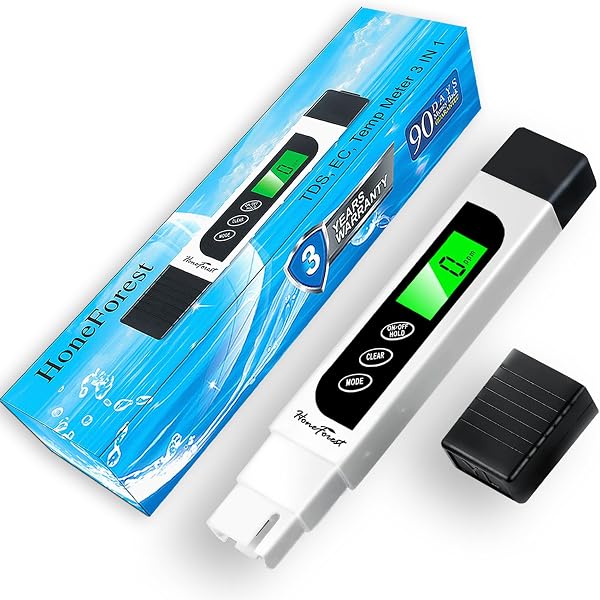
HoneForest TDS Meter
Check your RO water every few months. A creeping TDS number is your early warning that the membrane is aging — before you can taste it. 16,000+ reviews, under $15. ~$14.
Check Price on Amazon →How to Change RO Filters (Quick Version)
Filter changes are a 15-20 minute job:
- Turn off the feed water valve and the tank valve.
- Open the RO faucet to release pressure.
- Swap the filters. Most modern systems use twist-in or quick-change cartridges (no tools). Older systems use housings you open with the included wrench — keep a towel and bucket handy.
- For the membrane: pull the old one from its housing and insert the new one fully.
- Turn the water back on, check for leaks, and flush the new filters by draining the first full tank (carbon fines and preservative rinse out).
- Sanitize if you’re doing a major service (see below).
The exact filter orientation and which cartridge is which varies by system — follow your manual or the diagram on the unit. The same connections and care from our installation guide apply.
Annual Sanitizing (Tank Systems)
When you change the membrane (every 2-4 years) — or once a year if you want to be thorough — it’s good practice to sanitize a tank-based system. With the filters removed, add a small amount of unscented household bleach (per your manual, typically a few teaspoons) to the first housing, reassemble without filters, run it to fill and drain the tank once or twice, then install the new filters and flush. This clears any bacterial film that can develop in the tank over time. Tankless systems don’t have a storage tank, so this step is minimal or unnecessary.
Which Replacement Filters to Buy
You have two good options:
Match your system’s brand (best fit). Brand-specific filter sets are guaranteed to fit and often NSF-certified. iSpring, for example, sells multi-year sets for its systems:
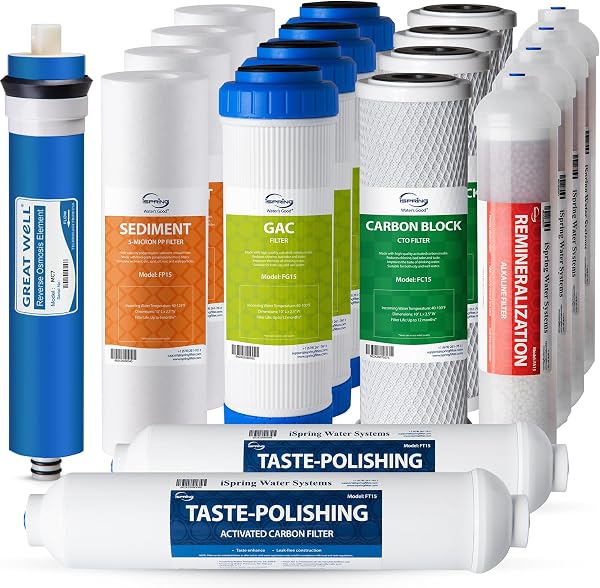
iSpring F19K75 — NSF-Certified 2-Year Filter Set
A 2-year supply of NSF-certified replacement filters for iSpring RO systems. 4.8 stars, 970+ reviews. Buying the multi-year set is cheaper per filter than one-offs. ~$140. (See our iSpring review.)
Universal standard-size sets (most systems). The majority of RO systems use standard 10-inch filter housings, so universal sets fit and cost less:
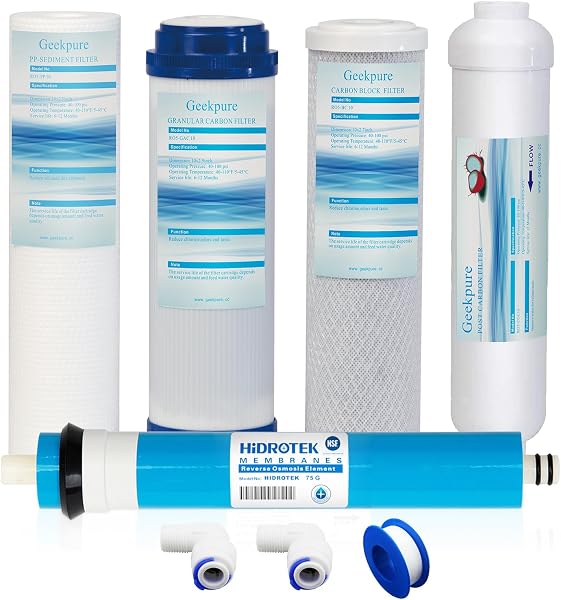
Geekpure 5-Stage Universal RO Filter Set
Fits most standard 5-stage RO systems with 10-inch housings, includes the membrane, 4.6 stars across 1,200+ reviews, around a third the price of branded sets. The value pick if your system uses standard housings. ~$36.
Before buying universal, confirm your system uses standard 10-inch housings (most do) rather than proprietary twist-in cartridges (some Waterdrop and tankless units), in which case you’ll want the brand’s own filters — see the Waterdrop, APEC, or Express Water reviews for each brand’s specifics.
What RO Maintenance Costs
The numbers are modest:
- Pre/post filters: roughly $30–$80/year depending on brand and whether you buy universal or branded.
- RO membrane: $30–$100 every 2-4 years (so ~$10–$30/year amortized).
- UV lamp (if equipped): ~$15–$30/year.
- Total: most households spend $50–$120/year to keep an RO system running — far less than bottled water, and the reason RO pays for itself over time.
Troubleshooting Common RO Problems
Most RO issues trace back to maintenance. Here’s a quick diagnostic guide:
| Symptom | Likely cause | Fix |
|---|---|---|
| No or very low water | Clogged pre-filters, empty/low tank, closed valve, low pressure | Check valves are open; replace pre-filters; confirm tank has air pressure (~7 psi empty) |
| Slow tank refill | Aging membrane or clogged filters; low feed pressure | Replace filters; test pressure; consider a booster pump |
| Water tastes bad again | Spent carbon filters or exhausted post-filter | Replace carbon and post filters |
| Rising TDS / less pure | Membrane wearing out | Replace the membrane; verify with a TDS meter |
| Gurgling / dripping noise | Normal for air-gap faucets; otherwise a drain-line issue | Check the drain line for kinks if it’s a non-air-gap setup |
| White residue / cloudy water | Air in new filters, or high-mineral remineralized water | Usually clears after flushing a tank or two |
| Water won’t shut off (constant drain) | Faulty check valve or shut-off valve | Replace the auto shut-off valve or check valve |
| Leaks | Tubing not fully seated, or a cracked fitting | Re-seat tubing firmly; replace over-tightened fittings |
If basic maintenance doesn’t resolve a problem, the membrane or a valve is usually the culprit — both are inexpensive, replaceable parts.
FAQ
How often should I change my reverse osmosis filters?
Pre-filters (sediment and carbon) every 6–12 months, the post-carbon filter every 12 months, and the RO membrane every 2–4 years. Heavy use or poor source water shortens these intervals; light use on clean municipal water extends them. When in doubt, annual pre/post filter changes are the safe default.
How long does an RO membrane last?
Typically 2–4 years, sometimes longer on good water with well-maintained pre-filters. The membrane’s lifespan depends heavily on whether you change the carbon pre-filters on time — chlorine that reaches the membrane (because the carbon is exhausted) destroys it early. Track membrane health with a TDS meter.
What happens if I don’t change my RO filters?
Flow slows as pre-filters clog, water quality and taste decline, and — most costly — chlorine breaks through the exhausted carbon and permanently damages the membrane. Skipping maintenance turns a 10-15 year system into a short-lived one. The cheap filters exist to protect the expensive membrane.
Can I use universal (generic) RO filters instead of brand-name ones?
Usually yes, if your system uses standard 10-inch filter housings (most do). Universal sets like Geekpure fit and cost less. The exception is systems with proprietary twist-in cartridges (some Waterdrop and tankless models), which need the brand’s own filters.
How do I know if my RO membrane is going bad?
Measure your RO water’s TDS with a meter. A healthy system keeps it well under 50 ppm; if the number climbs toward your tap water’s level over time, the membrane is losing rejection and it’s time to replace it. Slower production and worse taste are secondary signs.
Do tankless RO systems need different maintenance?
The filter-change concept is the same, but tankless systems use proprietary quick-change cartridges (no loose 10-inch filters), there’s no tank to sanitize, and many display a filter-life indicator. Otherwise the schedule — pre/post filters annually, membrane every few years — is similar.
Why is my reverse osmosis system producing water slowly?
The two most common causes are clogged pre-filters and low tank pressure (or an aging membrane). Replace the pre-filters if they’re overdue, check that the storage tank holds about 7 psi of air when empty, and confirm your feed pressure is adequate (50+ psi). If flow is still slow after fresh filters, the membrane may be near end of life.
Why does my RO water taste bad or different?
A return of chlorine taste means the carbon pre-filters are spent and need replacing; a stale or off taste points to an old post-filter. If the water tastes “flat,” that’s normal RO (consider a remineralization filter). Replacing the carbon and post filters on schedule prevents taste problems.
Bottom Line
Reverse osmosis maintenance is simple: change the pre- and post-filters about once a year, replace the membrane every 2-4 years, and watch your TDS to catch a fading membrane early. Staying on schedule protects the expensive membrane, keeps your water tasting clean, and stretches the system’s life to 10-15 years — all for $50-$120 a year. Match filters to your system (brand sets for proprietary cartridges, universal sets for standard housings), flush after every change, and your RO system will keep delivering.
Keep Reading
- How to Install a Reverse Osmosis System — the same skills apply to filter changes
- Best Reverse Osmosis Systems for Home — systems with easy-change filters
- What Is Reverse Osmosis Water? — how each stage works
- iSpring Review · APEC Review · Waterdrop Review — brand-specific filter info
- Reverse Osmosis Faucets — the one visible part of your system