Whole House RO vs Whole House Water Filter: Which Do You Actually Need?
PureFlow Lab is reader-supported. We may earn a commission when you buy through links in this guide — at no extra cost to you. As an Amazon Associate, we earn from qualifying purchases. See our Disclosure for details.
These two products get confused constantly, and they’re not the same thing — they don’t even solve the same problem. A whole house water filter improves the water flowing to every tap in your home (mostly chlorine, sediment, and taste). A whole house reverse osmosis system strips nearly everything out of all that water, including dissolved minerals — a far bigger, more expensive proposition. For the large majority of homes, the right answer isn’t one or the other; it’s a whole-house filter for general water quality plus a point-of-use RO at the kitchen for drinking water. Here’s how to tell what you actually need.
The Short Answer
- Whole house water filter (carbon-based): Treats all the water entering your home. Removes chlorine, sediment, bad taste and odor, and some chemicals. Keeps your water’s natural minerals. Affordable, high-flow, low-maintenance. Does not remove dissolved solids, fluoride, salts, or most heavy metals. This is what most homes actually need for whole-house water quality.
- Whole house reverse osmosis: Removes nearly everything — dissolved solids, heavy metals, fluoride, salts — from all the water in your home. Powerful but expensive, complex, water-wasting, and overkill for most situations. Reserved for problem water (very high TDS, brackish, specific contamination).
- What most homes should do: A whole-house carbon filter for shower/laundry/general water, plus a point-of-use RO system at the kitchen sink for purified drinking water. You get clean water everywhere and ultra-pure drinking water, without the cost and complexity of whole-house RO.
What a Whole House Water Filter Does
A whole house water filter (sometimes called a POE, “point of entry” filter) installs where the water main enters your home, so every tap, shower, and appliance gets treated water. Most are carbon-based — sometimes with a sediment pre-filter and a specialty stage.
What it does well:
- Removes chlorine and chloramine (the taste/smell of city water)
- Removes sediment (sand, rust, dirt)
- Reduces some VOCs, pesticides, and certain chemicals (depending on media)
- Improves taste and odor at every tap
- Keeps your water’s natural minerals — it’s not stripping the water, just cleaning it
- High flow rate (whole-house gallons per minute) and relatively low maintenance
What it doesn’t do: remove dissolved solids (TDS), fluoride, nitrates, salts, or most dissolved heavy metals. For those you need RO. A whole-house filter is about better water everywhere, not pure water.
An example of the category — Express Water’s whole-house filter, which targets sediment, chlorine, heavy metals, and PFAS across the whole home:
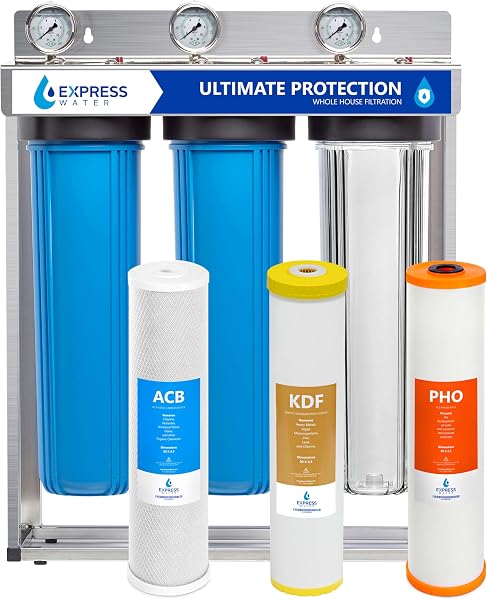
Express Water 3-Stage Whole House Filter
A representative whole-house filter: stainless frame, three stages targeting sediment, chlorine, heavy metals, scale, and PFAS for the whole home, with pressure gauges. 4.6 stars, 400+ reviews. Note this is a filter, not RO — it improves water everywhere but doesn’t purify like an RO system. ~$598.
What Whole House RO Does (and Why It’s Overkill for Most)
A whole house reverse osmosis system puts RO membranes at the point of entry, so all the water in your home is reverse-osmosis purified — drinking, showering, laundry, everything. It removes essentially everything a filter can’t: dissolved solids, fluoride, salts, heavy metals.
The problem is what comes with that:
- Cost: whole-house RO runs thousands to tens of thousands of dollars installed — far more than a filter.
- Complexity: it needs large storage tanks, a re-pressurization pump (RO output isn’t pressurized enough for whole-house use), and usually a remineralization stage (because RO water is corrosive to pipes and flat-tasting).
- Wastewater: RO produces wastewater, and doing it for your entire home’s water multiplies that.
- Overkill: you don’t need reverse-osmosis-pure water to shower or wash clothes. Purifying every gallon to drinking-water standard is wasteful for water you’re not drinking.
Whole-house RO genuinely makes sense in specific cases — very high TDS water, brackish or coastal supplies, certain well or agricultural contamination, or light commercial needs. For those, see our best whole house RO systems guide and whole house RO cost breakdown. For most homes, it’s more system than the situation calls for.
The Setup Most Homes Actually Want
Here’s the configuration that gives you the best of both without overpaying:
- A whole-house carbon filter at the point of entry — so every shower, tap, and appliance gets chlorine-free, sediment-free, better-tasting water, while keeping the minerals.
- A point-of-use RO system at the kitchen sink — so your drinking and cooking water is fully purified (dissolved solids, fluoride, and all).
This combination covers both goals: pleasant water throughout the house, and ultra-pure water where you actually drink it — at a fraction of the cost and complexity of whole-house RO. Our best reverse osmosis systems guide covers the point-of-use side, and the whole house vs under-sink RO guide digs deeper into the point-of-use decision.
Comparison Table
| Whole House Filter | Whole House RO | Point-of-Use RO | |
|---|---|---|---|
| Treats | Every tap | Every tap | Kitchen tap only |
| Removes chlorine/sediment | Yes | Yes | Yes |
| Removes dissolved solids/fluoride/salts | No | Yes | Yes |
| Keeps natural minerals | Yes | No (needs remineralization) | No (optional remineralization) |
| Wastewater | No | High | Low |
| Typical cost | $300–$1,500 | $$$$ (thousands+) | $150–$500 |
| Best for | General whole-home water quality | Problem water (high TDS, brackish) | Purified drinking water |
How to Decide
- You want better water at every tap (chlorine, taste, sediment) → whole house carbon filter.
- You want purified drinking water → point-of-use RO at the kitchen.
- You want both (most homes) → whole house filter + point-of-use RO.
- You have genuinely problem water (very high TDS, brackish, specific contamination affecting the whole home) → consider whole house RO, ideally after a water test confirms it’s warranted.
- On a well? Start with our best RO for well water guide — wells often need targeted treatment (iron, bacteria) more than blanket RO.
The 10-Year Cost Picture
Cost is where these options really diverge. Rough total-cost-of-ownership over 10 years:
| Option | Upfront | Ongoing (filters/etc.) | 10-Year Estimate |
|---|---|---|---|
| Whole house carbon filter | $300–$1,500 | ~$100–$300/yr | ~$1,300–$4,500 |
| Point-of-use RO (kitchen) | $150–$500 | ~$50–$120/yr | ~$650–$1,700 |
| Filter + point-of-use RO (recommended) | $450–$2,000 | ~$150–$420/yr | ~$2,000–$6,200 |
| Whole house RO | $5,000–$20,000+ installed | High (filters, membrane, pump electricity, wastewater) | $10,000+ |
The combination of a whole-house carbon filter plus a kitchen RO covers nearly every home’s needs for a fraction of whole-house RO’s cost — and you’re not paying to reverse-osmosis-purify the water you flush and shower with. Whole-house RO only pencils out when problem water genuinely requires treating every gallon.
FAQ
What’s the difference between a whole house water filter and reverse osmosis?
A whole house filter (usually carbon) cleans all your home’s water of chlorine, sediment, and taste while keeping its minerals — it improves water everywhere but doesn’t purify. Reverse osmosis strips nearly everything out, including dissolved solids and minerals, producing pure water. Filters are for general water quality; RO is for purified drinking water.
Do I need whole house RO or just a filter?
Most homes don’t need whole-house RO — it’s expensive and overkill for water you shower and wash with. The common best setup is a whole-house carbon filter for general quality plus a point-of-use RO at the kitchen for drinking. Whole-house RO is reserved for genuinely problem water (very high TDS, brackish, or specific contamination).
Can I have both a whole house filter and reverse osmosis?
Yes — and it’s the ideal setup for most homes. The whole-house filter handles chlorine, sediment, and taste at every tap; a point-of-use RO at the kitchen sink gives you fully purified drinking water. The filter also helps protect the RO membrane by removing chlorine and sediment upstream.
Why is whole house reverse osmosis so expensive?
Because it’s a much bigger system: RO membranes sized for whole-home flow, large storage tanks, a re-pressurization pump (RO output isn’t pressurized enough for household use), and a remineralization stage to keep the water from being corrosive to your pipes. Installed costs run into the thousands. See our whole house RO cost guide.
Does a whole house filter remove fluoride?
No. Whole house carbon filters don’t remove fluoride (or other dissolved ions). For fluoride you need reverse osmosis — see Does Reverse Osmosis Remove Fluoride?. This is exactly why many homes pair a whole-house filter with a point-of-use RO.
Will a whole house filter protect my reverse osmosis system?
Yes — and it’s a nice bonus of the filter-plus-RO combo. A whole-house carbon filter removes chlorine and sediment before water reaches your kitchen RO, which protects the RO membrane (chlorine damages membranes, sediment clogs pre-filters). So the two systems complement each other: the filter extends your RO’s life while improving water everywhere.
Do I need a water softener too?
Only if your water is hard (high calcium/magnesium), which a water test will tell you. Softeners solve scale and protect plumbing and appliances — a different problem than either a carbon filter or RO addresses. Many homes with hard water run a softener plus a carbon filter plus a point-of-use RO, each handling its own job.
Bottom Line
A whole house water filter and whole house RO solve different problems. The filter improves the water at every tap — chlorine, sediment, taste — affordably and while keeping minerals. Whole house RO purifies everything but is expensive, complex, and overkill for most homes. The setup that fits the large majority of households is a whole-house carbon filter plus a point-of-use RO at the kitchen — clean water everywhere, pure water where you drink it. Reserve whole-house RO for genuinely problem water, ideally confirmed by a water test.
Keep Reading
- Best Reverse Osmosis Systems for Home — the point-of-use side of the combo
- Best Whole House Reverse Osmosis Systems — if you truly need whole-house RO
- Whole House RO vs Under-Sink RO — the point-of-use decision in depth
- How Much Does a Whole House RO System Cost? — the real numbers
- Best RO Systems for Well Water — if you’re on a well
- What Is Reverse Osmosis Water? — filter vs purify, explained