
Best Whole House Reverse Osmosis Systems in 2026 (Ranked & Compared)
PureFlow Lab is reader-supported. We may earn a commission when you buy through links in this guide, at no extra cost to you. As an Amazon Associate, we earn from qualifying purchases. See our Disclosure for details.
Start with a water test. Whole-house RO is sized and pre-treated around your water: get your utility’s water quality report or a certified lab test (see our water testing guide) before choosing equipment.
Three of them (the iSpring units) are RO production units, not complete whole-house packages; each card says what you’d need to add. Amazon specs are as stated on each listing (checked September 30, 2026); we don’t lab-test products. US Water Systems and Crystal Quest sell direct, so check their sites for current specs and pricing. Check Amazon for current prices.
Not whole-house RO: a hybrid alternative
This bundle softens water for the whole house but only makes RO water at one drinking-water faucet. It’s here because many people searching for whole-house RO really want soft water everywhere plus purified drinking water.

Aquasure 64K Bundle: Softener + 75 GPD Drinking-Water RO
A 64,000-grain whole-house water softener plus a 75 GPD under-sink RO drinking water system (model AS-PR75HS64D), per Aquasure. The softener treats hardness at every fixture; the RO only treats water at its dedicated faucet. Not a whole-house RO system.
Check Price on Amazon →The gist: For most homeowners committed to whole-house RO, a pre-engineered package like the US Water Systems Defender is the simplest route, because the parts are chosen to work together. For larger homes, the iSpring CRO1000 is rated 1,000 GPD, but it’s an RO unit only: you add storage, a repressurization pump and pre-treatment. If what you really want is soft water everywhere plus RO drinking water, the Aquasure 64K bundle is a softener plus a 75 GPD drinking-water RO, not whole-house RO. If you have a large home or unusual contamination, configure a Crystal Quest system. Before you commit, read our whole house RO vs whole house filter and whole house vs under-sink RO comparisons. For many homeowners, a whole-house carbon filter plus under-sink RO is the better answer for far less money.
You’ve decided whole-house reverse osmosis is the right call for your situation, and now you need to pick a system. This guide compares five whole-house RO options (two complete packages and three RO units you build a system around), plus one softener + drinking-water RO hybrid, organized by capacity, configuration, and use case rather than as a single “best overall” list, because the right system depends on your situation.
This article is a product-focused comparison. If you’re still deciding whether whole-house RO makes sense, read whole house vs under-sink RO and what drives whole house RO cost first. They cover the bigger decision (whole-house vs hybrid vs under-sink) before you get into specific products.
How We Picked
We don’t lab-test or install these systems. For the Amazon picks, we used what each listing states (capacity, stages, pure-to-drain ratio, pressure requirements, what’s included), checked September 30, 2026. For the two direct-sold systems, we describe them only in general terms; confirm specs with the maker. We looked for:
- Real whole-house capacity: many “whole house RO” products are really under-sink units. We looked for systems rated 300+ GPD or sold as whole-house configurations.
- Pre-treatment you can plan for: chlorine damages RO membranes, and hardness and sediment foul them. We favored systems that include filter stages or make it clear what you need to add.
- Clear listing information: we left out listings that don’t state basic specs like capacity and what’s in the box.
What’s NOT in this guide: listings with no clear specs, and “whole house” systems that are actually point-of-use units in disguise.
Our Picks in Detail
Best Pre-Engineered Package: US Water Systems Defender
The US Water Systems Defender is a pre-engineered whole-house RO package from a water-treatment specialist. It’s sold direct, not on Amazon. The reason to consider it is integration: instead of sizing an RO unit, pre-filtration, storage and a delivery pump yourself, you buy a package that was put together to work as a whole.
We can’t verify its specs from an Amazon listing, so treat the maker as the source. Before buying, ask US Water Systems for the rated capacity, the pure-to-drain ratio, exactly what’s included (pre-filtration, storage tank, delivery pump, post-treatment), and what pre-treatment your water test calls for.
Whoever you buy from, whole-house RO is a bigger project than under-sink RO. Having a seller who can answer sizing and installation questions matters more here.
Pros: Sold as a pre-engineered package rather than loose components, from a water-treatment specialist. Cons: Direct purchase only (not Amazon), specs and inclusions have to be confirmed with the maker, less flexible than a configured Crystal Quest system.
Best High-Capacity: iSpring CRO1000 (1,000 GPD Commercial Tankless)
iSpring CRO1000 (1,000 GPD Commercial Tankless)
1,000 GPD (0.7 GPM) commercial tankless RO, 4-stage with 20" x 4.5" filters, inlet and outlet pressure gauges, on a wheeled frame, according to the listing. Needs 80 to 130 psi; iSpring offers an optional PMP1000 booster pump below 80 psi. RO unit only. For whole-house use you also need an atmospheric storage tank, a repressurization (delivery) pump, and whatever pre- and post-treatment your water test calls for.
Check Price on Amazon →The iSpring CRO1000 is the pick for larger homes. The listing describes a 1,000 GPD commercial tankless system with 4 stages using 20" x 4.5" filters, inlet and outlet pressure gauges, and a wheeled frame.
Two listing details matter for whole-house use. First, it needs 80 to 130 psi feed pressure; if your home is below 80 psi, iSpring offers an optional PMP1000 booster pump. Second, 1,000 GPD works out to 0.7 GPM.
That second number is the key to whole-house RO sizing. A running shower alone uses more than 0.7 GPM, so no RO unit in this guide can feed household demand directly. Whole-house RO systems make water continuously into a storage tank, and a delivery pump sends it to your fixtures. Higher GPD means the tank refills faster between peaks.
Pros: 1,000 GPD, larger 20" x 4.5" filter housings, inlet and outlet gauges, wheeled frame. Cons: Needs 80 to 130 psi (booster pump sold separately), you still need a storage tank and delivery pump for whole-house use, pure-to-drain ratio not stated on the listing, more capacity than small households need.
Best Entry-Level Tankless: iSpring RCB3P (300 GPD)
iSpring RCB3P (300 GPD Light Commercial Tankless)
300 GPD tankless with a booster pump, pressure gauge, stainless frame, and a 1.5:1 pure-to-drain ratio, the listing says. 300 GPD averages only about 0.21 gallons per minute over a day, far below a household’s peak flow. RO unit only. For whole-house use you also need an atmospheric storage tank, a repressurization (delivery) pump, and whatever pre- and post-treatment your water test calls for.
Check Price on Amazon →The iSpring RCB3P is a 300 GPD tankless unit that iSpring rates for residential and light commercial use. It has a booster pump, a pressure gauge, a stainless frame, and a 1.5:1 pure-to-drain ratio. 300 GPD is on the small end for whole-house RO, so it suits smaller homes. Averaged over a day, 300 GPD is only about 0.21 gallons per minute, so it can’t feed fixtures directly; it fills a tank.
The 1.5:1 ratio means 1.5 gallons of pure water for every gallon sent to drain, which matters at whole-house volumes, especially on a well or metered water. A storage tank is optional and not included; iSpring says it works with its 11- or 20-gallon tanks. For whole-house use you’d typically plan a larger atmospheric storage tank plus a repressurization (delivery) pump, as in US Water Systems’ whole-house RO install guide.
This is a component, not a complete whole-house system. You’ll need to add storage, a delivery pump, and any pre-treatment your water test calls for, and do the sizing yourself.
Pros: 1.5:1 pure-to-drain ratio, booster pump and pressure gauge included, stainless frame. Cons: Tank not included, 300 GPD is limited for larger households, requires more DIY planning than a pre-engineered package.
Best Mid-Capacity Tankless: iSpring RCS5T (500 GPD)
iSpring RCS5T (500 GPD Commercial RO)
500 GPD commercial tankless, 5-stage, 1.5:1 pure-to-drain ratio, booster pump, pressure gauge and chrome faucet, per iSpring. 500 GPD averages about 0.35 gallons per minute. RO unit only. For whole-house use you also need an atmospheric storage tank, a repressurization (delivery) pump, and whatever pre- and post-treatment your water test calls for.
Check Price on Amazon →The iSpring RCS5T is a step up from the RCB3P for mid-size households. The listing gives 500 GPD commercial tankless, 5-stage, a 1.5:1 pure-to-drain ratio, a booster pump, a pressure gauge, and a chrome faucet.
If you’re unsure whether 300 GPD is enough, compare current prices for the RCB3P and RCS5T on Amazon; the extra capacity gives you more headroom to refill a storage tank.
Like the RCB3P, it’s the RO unit, not a complete whole-house system. Plan for storage, a delivery pump, and whatever pre-treatment (sediment filtration, softening, iron removal) your water test calls for.
Pros: 500 GPD, 5-stage, 1.5:1 pure-to-drain ratio, booster pump and pressure gauge included. Cons: Storage and delivery pump not included, slightly larger footprint than the RCB3P.
Best Configurable System: Crystal Quest Whole House RO
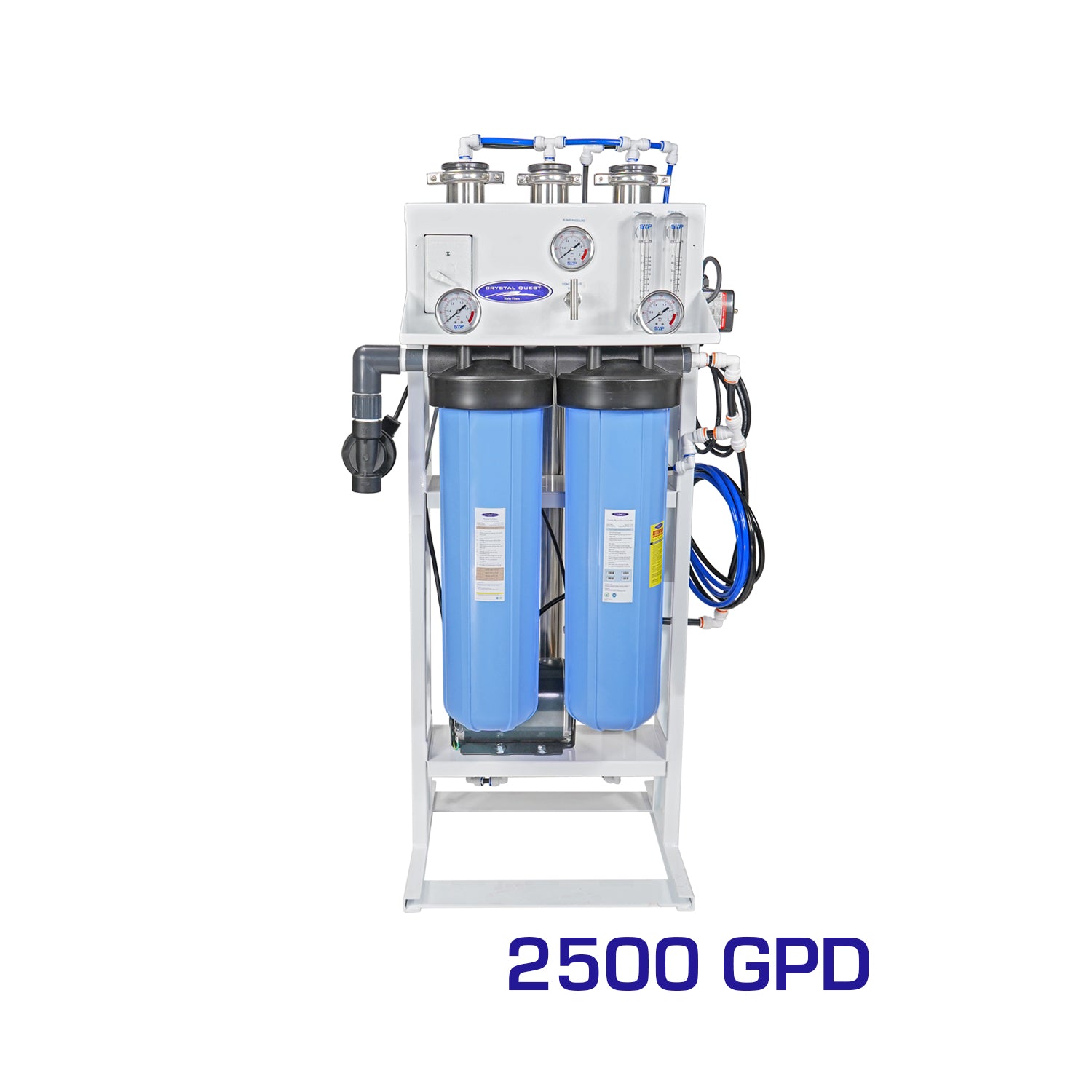
Crystal Quest Whole House RO
A configurable whole-house RO system from a water-treatment company, sold direct. For large homes or unusual water problems where you want the system sized around your water test. Ask Crystal Quest which storage, pumps and pre-treatment are included in the configuration you’re quoted.
The Crystal Quest Whole House RO is a configurable system from a water-treatment company, sold direct. It’s the pick for large homes, unusual contamination, or anyone who wants the system designed around their water test rather than fitting their house to an off-the-shelf unit.
Configurable systems let you choose membrane capacity, storage and pumps. Ask Crystal Quest to size each piece from your water test and household demand, and to put the configuration, the pre-treatment, and the price in writing.
Expect a custom system to cost more than an off-the-shelf unit, and get at least two quotes for installation.
Pros: Configurable to your water and household, sized around your water test. Cons: Specs and pricing come only from the maker, more decisions during purchase than off-the-shelf systems, typically needs professional installation given the scale.
Hybrid Alternative (Not Whole-House RO)
Softener + Drinking-Water RO: Aquasure 64K Bundle
The Aquasure 64K Grain Whole House Bundle is the right pick if you have hard water AND want RO drinking water and prefer to buy both in one purchase.
According to the listing, the bundle includes a 64,000-grain whole-house water softener (hardness treatment for the whole home: showers, dishwasher, laundry) plus a 75 GPD reverse osmosis drinking water system for the kitchen sink. Aquasure sizes it for homes with 4 to 5 bathrooms and offers up to a 5-year warranty. It’s sold by Aquasure USA.
This is a hybrid setup, not true whole-house RO: the RO portion only treats drinking water at the dedicated tap. But for many homeowners researching whole-house RO, the real concerns are “hard water at every fixture” plus “purified drinking water at the kitchen tap,” and this covers both. See our whole house RO vs under-sink RO comparison for why the hybrid approach is the right answer for many buyers.
Pros: Softener and RO in one purchase, addresses both hardness and drinking water, up to 5-year warranty. Cons: Not true whole-house RO: purified water only at the dedicated RO faucet. If you need RO water for showering or every tap, this won’t do it.
What to Look For (Quick Reference)
For the whole-house-versus-hybrid decision itself, see whole house vs under-sink RO. The quick summary:
Capacity (GPD). Match to household size, as a rough starting point: 300 GPD for 1-2 people, 500 GPD for 3-4 people, 800-1,000 GPD for 5+ people. Size the storage tank to cover your peak-day demand.
Storage and delivery. Even “tankless” units like the iSpring RCB3P, RCS5T and CRO1000 produce water far slower than a household uses it (1,000 GPD is only 0.7 GPM), so whole-house setups need a storage tank and a delivery pump. Plan floor space for the tank.
Pre-treatment. Chlorine damages RO membranes, and hardness, iron and sediment foul them. Some units include filter stages (the CRO1000 is 4-stage and the RCS5T is 5-stage, per their listings), but at whole-house flow you may also need a softener or other pre-treatment. Your water test decides this.
Wastewater ratio. The iSpring RCB3P and RCS5T list 1.5:1 (1.5 gallons of pure water per gallon to drain). Some older or basic RO designs send more water to drain than they produce. At whole-house volumes, that difference adds up fast.
Installation requirements. Whole-house RO systems need floor space for the equipment and storage tank, drain access, electrical for the pumps, plumbing access at the main water entry, and cold-protected space (no freezing). Check the feed-pressure range on the listing, too: the CRO1000 needs 80 to 130 psi.
Comparison Table
Amazon specs per each listing (checked September 30, 2026). “Not stated” means the listing doesn’t say.
| System | Capacity | Type | Stages | Wastewater | Best For | Price |
|---|---|---|---|---|---|---|
| US Water Defender | Check with maker | Pre-engineered package | Check with maker | Check with maker | Buyers who want a complete package | See maker |
| iSpring CRO1000 | 1,000 GPD (0.7 GPM) | RO unit (add storage + repressurization pump) | 4 (20" x 4.5") | Not stated | Larger homes; needs 80 to 130 psi | Check price |
| iSpring RCB3P | 300 GPD | RO unit (add storage + repressurization pump) | Not stated | 1.5:1 | Smaller homes, DIY builds | Check price |
| iSpring RCS5T | 500 GPD | RO unit (add storage + repressurization pump) | 5 | 1.5:1 | Mid-size households, DIY builds | Check price |
| Crystal Quest | Configurable | Configurable | Configurable | Check with maker | Large homes / custom configs | See maker |
| Aquasure Bundle | 75 GPD RO (drinking only) + 64,000-grain softener | Hybrid (not whole-house RO) | Not stated | Not stated | Hard water + drinking water | Check price |
Matching a Whole-House System to Your Home
| Your Situation | Right Pick | Why |
|---|---|---|
| Want true whole-house RO as a complete pre-engineered system | US Water Defender | Sold as a package; one seller to ask about sizing |
| Smaller household, comfortable with DIY sizing | iSpring RCB3P + storage tank + delivery pump | 300 GPD, 1.5:1, booster pump included; you do the system design |
| 3-4 person household, comfortable with DIY sizing | iSpring RCS5T + storage tank + delivery pump | 500 GPD, 5-stage, 1.5:1 |
| 5+ person household, large home | iSpring CRO1000 | 1,000 GPD refills storage faster; check the 80 to 130 psi requirement |
| Large home with unusual contamination (high TDS, nitrates) | Crystal Quest configured | Sized around your water test |
| Hard water + want RO drinking water (not whole-house RO) | Aquasure 64K Bundle | Softener plus 75 GPD RO drinking system in one purchase |
| Not sure if whole-house RO is actually what I need | Read whole house RO vs under-sink RO first | The hybrid setup might be the right answer for you |
Sizing Quick Guide
Daily use below is based on the U.S. Geological Survey’s estimate that each person uses about 80 to 100 gallons of water a day at home. Your own water bill is a better guide.
| Household Size | Daily Water Use (Total) | Recommended RO Capacity | Recommended Pick |
|---|---|---|---|
| 1-2 people | 80-200 GPD | 300 GPD | iSpring RCB3P |
| 3-4 people | 240-400 GPD | 500 GPD | US Water Defender or iSpring RCS5T |
| 5-6 people | 400-600 GPD | 800-1,000 GPD | iSpring CRO1000 |
| 7+ people / very large home | 560+ GPD | Custom-sized | Crystal Quest configured |
Storage tank size, peak demand and inlet pressure change the answer: a 500 GPD unit with a 40-gallon tank handles morning showers that a 1,000 GPD unit with no tank cannot. The installation section below covers what each pick needs added.
Before You Order: Installation Requirements
Whole-house RO is not a weekend DIY project for most homeowners. Before you order a system, confirm you have:
- Space. A complete system with storage tank and pumps needs real floor space and vertical clearance for the tank. Garages, utility rooms, and basements are the common locations.
- Drain access. Wastewater needs a dedicated drain: floor drain, utility sink, or outside line. Check the unit’s pure-to-drain ratio to estimate the volume.
- Electrical. Booster and delivery pumps need power; check each pump’s requirements.
- Plumbing access. The system installs at your home’s main water entry point, after the meter and before any branches to the house.
- Cold-protected space. RO membranes and storage tanks can’t freeze. Garage installs in cold climates need heated/insulated enclosures.
Plan for a full day of work and a water shutoff; a plumber is recommended for the main water cut-in.
Maintenance Schedule for a Whole-House RO
| Task | Frequency | Notes |
|---|---|---|
| Check pre-filter pressure gauge | Monthly | A growing pressure drop means a clogging filter |
| Replace sediment pre-filter | Every 6 months (or per maker) | Protects everything downstream |
| Replace carbon pre-filter | Every 6-12 months (or per maker) | Chlorine damages RO membranes |
| Sanitize storage tank | Annually | DIY or hire a pro |
| Test RO output TDS | Quarterly | A digital TDS meter is a one-time purchase |
| Replace RO membrane | When TDS rejection drops | Usually the most expensive cartridge |
| Replace post-treatment media | Annually (or per maker) | Remineralization/calcite media gets used up |
| Inspect booster pump and tank | Annually | Replace parts as needed |
The most common way to shorten a membrane’s life is skipping pre-filter replacement. Chlorine damages RO membranes, and a carbon pre-filter is much cheaper than a membrane. Don’t skip it.
Common Problems and What They Usually Mean
Slow water at the tap. Usually a storage tank or delivery pump issue, not the RO itself. Check that the tank isn’t running empty, verify the delivery pump is engaging, and check for clogged post-filters.
TDS rising over time. The membrane may be failing, or a pre-filter may be spent. Compare TDS before and after the membrane; if rejection has dropped noticeably from when the system was new, it’s time to replace the membrane.
Excessive wastewater. Some wastewater is normal. Excessive wastewater usually means a stuck flow restrictor or a failing automatic shutoff valve. Units that list better ratios, like the iSpring RCB3P at 1.5:1, send less water to drain than designs that list worse ratios or none at all.
Acidic / “flat” tasting water. This is normal for RO water, which is low in minerals. Add a post-treatment remineralization filter to add some minerals back. Some under-sink RO systems like the iSpring RCC7AK include this stage built in.
Membrane fouling. Common on well water with iron, manganese, or biological contamination. The fix is better pre-treatment, typically adding an iron filter or UV upstream of the RO.
These three sections were merged here in October 2026 from our former whole-house buyer's guide, which now redirects to this page. Step-by-step under-sink installation lives on the installation guide; filter timing for every RO type is on the maintenance schedule.
Where to Buy Our Picks

US Water Systems Defender Whole House RO
A pre-engineered whole-house RO package from a water-treatment specialist, sold direct rather than on Amazon. US Water Systems’ install guide shows the Defender sending purified water to a storage tank, with a repressurization pump feeding the house. Confirm capacity, what’s included, and pre-treatment needs with the maker before you buy.
FAQ
What’s the best whole house reverse osmosis system?
For most homeowners who are sure they want whole-house RO, a pre-engineered package like the US Water Systems Defender is the simplest route, since the parts are chosen to work together; confirm specs with the maker. For larger homes building their own setup, the iSpring CRO1000 is rated 1,000 GPD.
What’s the least expensive way to get whole house RO?
Usually a bare RO unit like the iSpring RCB3P that you build a system around. But it’s a unit-only purchase: you’ll need to add a storage tank, a delivery pump, and any pre- and post-treatment your water needs. Price out the full parts list and installation before comparing it with a complete package.
Are tankless whole house RO systems better than tank-based?
For whole-house use, the distinction matters less than it does under the sink. Even the highest-capacity unit here (1,000 GPD) makes only about 0.7 GPM, so every whole-house RO setup needs storage and a delivery pump. What “tankless” units like the iSpring models add is higher production and a built-in booster pump, which refills your storage faster. They need electricity, and the CRO1000 needs 80 to 130 psi feed pressure.
How big a system do I need for a family of 4?
Using the USGS estimate of 80 to 100 gallons per person per day, a 4-person household uses roughly 320 to 400 gallons a day. Add some margin and you land around 500 GPD plus adequate storage. The iSpring RCS5T (500 GPD) is sized for this; for the US Water Defender, confirm the rated capacity with the maker.
Do I need a softener with a whole house RO system?
Often yes, especially with hard water. Calcium and magnesium scale on the membrane surface and shorten its life. The Aquasure bundle includes a softener; if you go with a different RO system, get a water test and ask whether you need a softener upstream as pre-treatment.
What’s the difference between residential and commercial RO systems?
Mostly capacity and intended use. Typical under-sink residential RO is rated 50-100 GPD for tank systems and a few hundred GPD for tankless. The commercial units here are rated higher: the iSpring RCS5T at 500 GPD and the iSpring CRO1000 at 1,000 GPD, which is why they come up for whole-house use. Check feed-pressure requirements: the CRO1000 needs 80 to 130 psi.
Can I install a whole house RO system myself?
Possible but not recommended unless you’re comfortable with plumbing (main water line modifications, bypass valve installation), electrical (pump wiring), and water-treatment system design. A pre-engineered package like the US Water Defender takes the component matching off your plate. Configured Crystal Quest systems typically require professional installation. Get at least two local installer quotes. See our whole house RO cost guide for what drives installation cost.
Bottom Line: Which Whole House RO Should You Buy?
For most homeowners committed to whole-house RO, a pre-engineered package like the US Water Systems Defender is the simplest route. Confirm specs and what’s included with the maker.
For larger homes (5+ residents), the iSpring CRO1000 is rated 1,000 GPD. Check the 80 to 130 psi pressure requirement, and plan for storage and a delivery pump.
For smaller homes building a DIY setup, the iSpring RCB3P (300 GPD) or iSpring RCS5T (500 GPD) are the core RO units. Plan for storage, a delivery pump, and pre-treatment to complete the system.
For large homes, unusual contamination, or custom configurations, configure a Crystal Quest Whole House RO system and get the configuration and price in writing.
If you don’t actually need whole-house RO but want soft water plus RO drinking water, the Aquasure 64K Bundle combines a softener and a 75 GPD RO drinking system in one purchase.
Honest reminder: before you commit to whole-house RO, make sure you actually need it. For many homeowners, the hybrid setup (whole-house carbon filter + under-sink RO) covers what they care about for far less money. Note that a whole-house carbon filter doesn’t reduce TDS (Aquasana says so on its Rhino listing), so it’s the under-sink RO that handles dissolved solids. See our whole house RO vs under-sink RO comparison for the full decision framework.
Ready to buy?
Check current pricing on whichever pick fits your situation:
Shop Whole House RO Systems on Amazon → | See US Water Defender → | Configure on Crystal Quest →
If this helped, share it with someone shopping for whole-house water treatment.
Keep Reading
- Whole House RO vs Whole House Filter: which one you actually need
- Best RO Systems for Well Water: UV and booster-pump picks for wells
- Whole House RO vs Under-Sink RO: Which Should You Buy? (comparison and hybrid setup)
- Whole House RO Cost: What Drives It: what drives the cost
- Best Reverse Osmosis Systems for Home (Under-Sink Picks): if drinking water only is the actual need
Primary sources
Maker documentation for the system designs described above: