Reverse Osmosis Wastewater: Is It Really 4:1? (And How to Cut It)
PureFlow Lab is reader-supported. We may earn a commission when you buy through links in this guide — at no extra cost to you. As an Amazon Associate, we earn from qualifying purchases. See our Disclosure for details.
It’s the single most common objection to reverse osmosis: “Doesn’t it waste a ton of water?” The honest answer is yes, RO produces some wastewater — but the “4 gallons wasted for every 1 you drink” figure you’ve probably heard is outdated. Modern systems are dramatically more efficient, the real-world amount is smaller than it sounds in household context, and there are concrete ways to cut it further. Here’s the straight story.
The Short Answer
Reverse osmosis produces a “wastewater” stream — the water that carries rejected contaminants down the drain. How much depends on the system:
- Older tank-based systems: roughly 3:1 to 4:1 (3-4 gallons to drain per gallon of pure water). This is where RO’s wasteful reputation comes from.
- Modern tankless systems: typically 1:1 to 2:1 — a huge improvement, and the reason the old reputation is outdated.
- Permeate-pump systems: cut wastewater by up to 80% versus a standard system.
In real numbers, a household drinking and cooking with RO uses only a few gallons of drinking water a day, so even at a 2:1 ratio the wastewater is a small fraction of what the home already sends down the drain from toilets, showers, and laundry. It’s a real consideration — not the dealbreaker it’s often made out to be.
What “Wastewater” Actually Is
To purify water, the RO membrane separates it into two streams: the permeate (your clean drinking water) and the concentrate or reject (water carrying the rejected dissolved solids and contaminants, sent to the drain). That reject stream is what’s called wastewater.
It’s worth being precise about what it is and isn’t. RO wastewater is not sewage — it’s just your tap water with a higher concentration of the minerals and contaminants the membrane removed. It’s flushed continuously to keep the membrane from fouling. Calling it “wasted” is fair in that it goes down the drain, but it’s clean enough that, with care, some of it can be reused (more below).
The Ratios, Explained
The pure-to-drain ratio is the key spec, and it has improved a lot:
| System Type | Typical Pure : Drain | Notes |
|---|---|---|
| Older / budget tank systems | 1 : 3 to 1 : 4 | The source of RO’s “wasteful” reputation |
| Quality tank systems | 1 : 2 to 1 : 3 | Better membranes and flow restrictors |
| Modern tankless systems | 1 : 1 to 2 : 1 | Pure-to-drain often better than 1:1 |
| Permeate-pump systems | Up to 80% less waste | Non-electric pump recovers energy from the reject stream |
Note that manufacturers state the ratio in different directions (pure:drain vs drain:pure), so read carefully — a “2:1 pure to drain” system produces 2 gallons of clean water per 1 gallon to drain, which is efficient.
How Much Water Does RO Really Waste?
Context matters here. A typical household uses RO only for drinking and cooking — a few gallons a day. Even on the wasteful end:
- Drinking/cooking water: roughly 2-5 gallons/day of pure water for a family.
- At a 2:1 modern ratio, that’s about 1-2.5 gallons/day to drain.
- For comparison, a single toilet flush is ~1.6 gallons, a shower is 15-25 gallons, and a load of laundry is 15-30 gallons.
So RO wastewater is usually a rounding error against the home’s total water use. It’s a more meaningful concern if you’re on a well (you pay to pump every gallon), in a drought/water-restricted area, or running RO at high volume — in which case the efficiency upgrades below matter more.
How to Cut RO Wastewater
If efficiency matters to you, there are real options:
1. Choose a tankless system. Modern tankless RO systems commonly hit 1:1 to 2:1 ratios — far better than old tank systems. The Waterdrop G3P600, for example, runs a 2:1 pure-to-drain ratio.
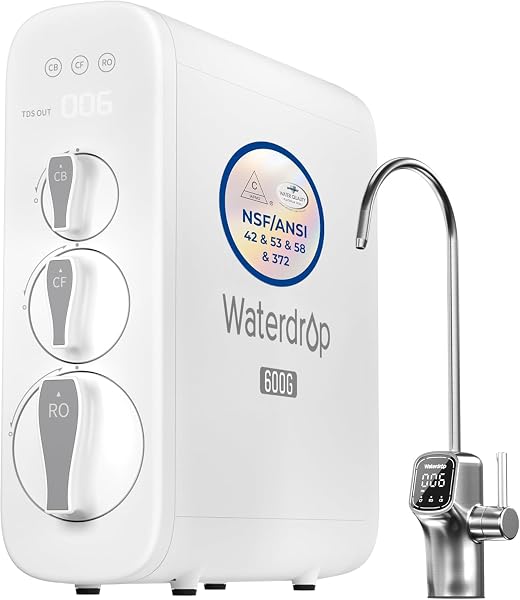
Waterdrop G3P600 — Tankless, 2:1 Wastewater Ratio
A mainstream tankless system with an efficient 2:1 pure-to-drain ratio — roughly half the waste of a legacy tank system — plus the full NSF certification stack. ~$399–$539. See our Waterdrop review.
2. Add a permeate pump. A non-electric permeate pump recovers energy from the reject stream to cut wastewater by up to 80% — the most effective efficiency upgrade for a tank system, and it needs no power. APEC’s Ultimate RO-PERM is built around one:
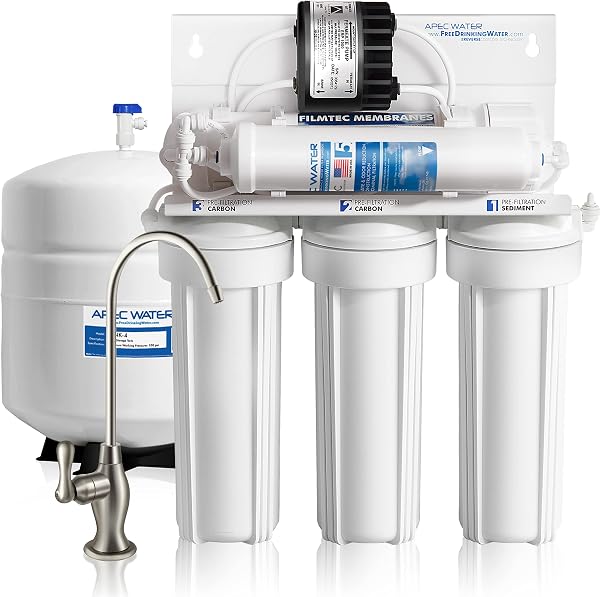
APEC Ultimate RO-PERM — Permeate Pump (−80% Waste)
A permeate-pump system that slashes wastewater up to 80% while boosting output — no electricity required. The efficiency pick, especially for wells and low-pressure homes. ~$340. See our APEC review.
3. Keep your water pressure up. RO efficiency depends on good feed pressure (ideally 50+ psi). Low pressure increases waste, so a booster pump on low-pressure homes/wells both improves output and reduces the drain ratio.
4. Maintain the system. Clogged pre-filters and an aging membrane both worsen the ratio. Staying on your maintenance schedule keeps efficiency where it should be.
5. Reuse the reject water (with care). RO wastewater is just concentrated tap water — not sewage — so some people collect it for non-drinking uses: watering ornamental plants (not edibles, due to higher mineral concentration), cleaning, or flushing. It takes a little plumbing or a collection container, and you should avoid it for salt-sensitive plants, but it’s a legitimate way to make the “waste” useful.
How to Calculate Your System’s Ratio
Want to know your actual pure-to-drain ratio? It’s a simple measurement:
- Disconnect the two output lines temporarily — the line going to your tank/faucet (pure) and the line going to the drain (reject) — and run each into a separate measuring container.
- Run the system for a set time (say, a few minutes) and measure how much collects in each container.
- Divide. If you collected 2 cups of pure water and 4 cups of drain water, your ratio is 1:2 (pure:drain). If you got 2 cups pure and 2 cups drain, you’re at 1:1.
If your measured waste is much higher than the manufacturer’s spec, the usual culprits are low feed pressure, a clogged flow restrictor, or an aging membrane — all fixable. Restoring pressure (or adding a booster/permeate pump) and staying current on maintenance keeps the ratio where it should be.
FAQ
How much water does a reverse osmosis system waste?
It depends on the system. Older tank systems waste 3-4 gallons per gallon of pure water; modern tankless systems run 1:1 to 2:1; permeate-pump systems cut waste up to 80%. In household terms, a family’s RO drinking water sends only 1-2.5 gallons/day to the drain on a modern system — small next to toilets, showers, and laundry.
Is reverse osmosis bad for the environment?
It produces some wastewater, but in context it’s a small share of household use, and it avoids the plastic waste and transport footprint of bottled water. Choosing a tankless or permeate-pump system minimizes the waste, and the reject water can be reused for non-drinking purposes. For most homes, RO is more environmentally friendly than bottled water.
Can I reuse reverse osmosis wastewater?
Yes, with care. RO reject water is concentrated tap water (not sewage), so it can be collected for watering ornamental plants, cleaning, or flushing toilets. Avoid using it on salt-sensitive or edible plants because of the higher mineral concentration. Reusing it turns the “waste” into a resource.
What is the most water-efficient reverse osmosis system?
Tankless systems (1:1 to 2:1) and permeate-pump systems (up to 80% less waste) are the most efficient. The APEC Ultimate RO-PERM is built specifically around efficiency, and modern tankless units like the Waterdrop G3P600 are far better than legacy tank systems.
Why does reverse osmosis need to waste any water at all?
The reject stream continuously flushes the contaminants the membrane removes off its surface — without it, the membrane would foul and fail quickly. So some wastewater is inherent to how RO works; the goal isn’t to eliminate it but to minimize it with efficient design.
Does reverse osmosis wastewater go down the sewer?
Yes, in a standard install the reject water connects to your sink’s drain line and goes to the sewer (or septic) like any other drain water. It’s not hazardous — just concentrated tap water — so it’s fine for the drain. If you’d rather not send it to the drain, some people reroute it to a collection container to reuse for plants or cleaning.
Will a permeate pump work on my existing RO system?
In many cases, yes — a permeate pump can be added to compatible standard tank-based RO systems to cut wastewater and boost output, without electricity. Compatibility depends on your system’s design, so check before buying. If you’re shopping new and efficiency is a priority, a system built around one (like the APEC RO-PERM) is the simplest route.
Bottom Line
Reverse osmosis does produce wastewater — but the “4:1” reputation is outdated. Modern tankless systems run 1:1 to 2:1, permeate-pump systems cut waste up to 80%, and in real household terms the amount is small next to everyday water use. If efficiency matters to you — especially on a well or in a water-restricted area — choose a tankless or permeate-pump system, keep your pressure and maintenance up, and reuse the reject water where practical. It’s a real factor, not a reason to skip RO.
Keep Reading
- Best Tankless Reverse Osmosis Systems — the most water-efficient designs
- APEC Reverse Osmosis Review — the permeate-pump RO-PERM in depth
- What Is Reverse Osmosis Water? — how the reject stream works
- Best Reverse Osmosis Systems for Home — efficient picks across the field
- RO System Maintenance Schedule — maintenance keeps efficiency high